Skip to main content
The Apple Earthquake: Tim Cook Steps Down After 15 Years. Here's What It Means for You (Even If You Don't Own a Single Share)
- April 21, 2026
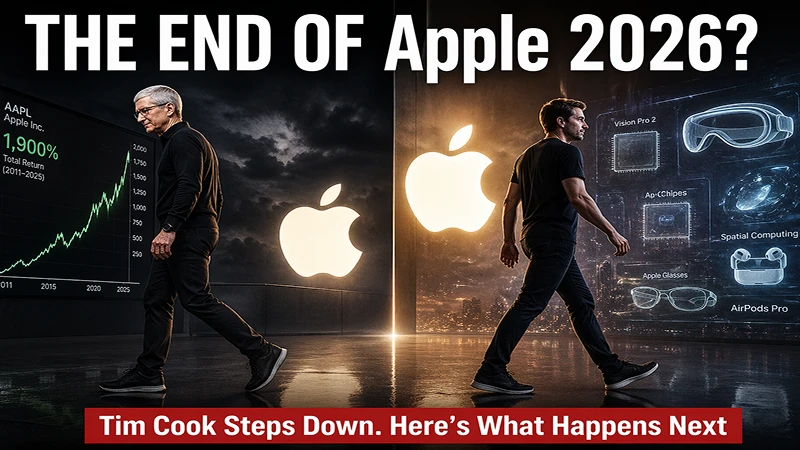
If you woke up this morning... April 21, 2026, grabbed your iPhone, and scrolled through your notifications, you probably saw the headline that stopped the tech world in its tracks: Tim Cook Is Stepping Down As CEO Of Apple.
After nearly 15 years at the helm of the most valuable company on Earth, the man who took the impossible job of following Steve Jobs is handing over the reins. Effective September 1, 2026, Tim Cook will transition to the role of Executive Chairman of Apple's Board of Directors. Taking his place in the CEO's chair will be John Ternus, Apple's longtime hardware engineering chief.
If you're sitting in a coffee shop in Austin, a co-working space in Brooklyn, or a home office in San Diego, you might be thinking: "Okay, Cool. Rich Guy Changes Jobs. Why Should I Care?"
I'll tell you exactly why you should care. This isn't just another corporate reshuffling. This is the end of one era and the beginning of another and the ripple effects will touch your apps, your devices, your job opportunities, and maybe even your next freelance gig. In the hours since the announcement, millions of Americans have flooded Google with the same questions: Who Is John Ternus? What Happens To Apple Now? Is This Good Or Bad For My Tech Career?
You came here looking for answers. This article will give you every single one of them.
🍎 The Announcement That Broke the Internet
Let's start with the facts, because there's already a lot of noise out there.
On Monday, April 20, 2026, Apple made it official. Tim Cook, who has led the company since August 2011, Will Step Down As CEO On September 1, 2026. He will not be leaving Apple entirely. Instead, he will take on the newly created role of Executive Chairman of the board, a position that will keep him involved in the company's long-term strategic direction while handing over day-to-day leadership to his successor.
The timing is significant. Cook is now 65 years old, an age when many top executives begin contemplating their next chapter. But this is not a retirement. In Apple's own words, Cook will "Remain CEO Through The Summer And Work Closely With Ternus To Ensure A Smooth Handover."
The new CEO, John Ternus, is not a household name at least, not yet. But inside Apple, he is a legend. At 50 years old, Ternus Has Spent 25 Years At Apple, almost his entire professional life. He Joined The Company In 2001 as a product design engineer and rose through the ranks to become Senior Vice President Of Hardware Engineering In 2021. He has had his hands on nearly every major hardware product Apple has released in the past two decades.
The internet's reaction was immediate and intense. Within hours, "Tim Cook" and "Apple CEO" were trending across every major platform. X (formerly Twitter) lit up with reactions ranging from nostalgia to anxiety to cautious optimism. One prominent tech analyst, Dan Ives of Wedbush Securities, captured the mood perfectly when he wrote: "The era of the operations king is drawing to a close... Apple is making a major transition on its AI strategy and longtime CEO and legendary Cook leaving now is a surprise. We agree with Ternus as the pick."
Wall Street's reaction was more muted but telling. Apple Shares Slipped Less Than 1% In After-hours Trading A Remarkably Calm Response For A Company that just announced its first CEO transition in 15 years. This suggests that investors, while cautious, largely trust the succession plan.
📊 The Cook Legacy: 1,900% Returns and a $4 Trillion Empire
To understand why this transition matters so much, you have to understand what Tim Cook built.
When Cook Took Over From Steve Jobs In August 2011, the world held its breath. Jobs was a singular figure a product visionary, a showman, a cultural icon. Cook was an operations guy, known for his mastery of supply chains and logistics, not for his stage presence. Many wondered: Could an operations guru keep Apple innovative?
The numbers speak for themselves. Over Cook's 15-year tenure as CEO, Apple's Stock Has Risen 1,932%, Crushing The S&P 500's 504% Gain Over The Same Period. The company's market capitalization soared from roughly $350 Billion To Over $4 Trillion, making it the most valuable publicly traded company in history.
But the numbers only tell part of the story. Under Cook, Apple didn't just sell more iPhones. It fundamentally transformed its business model:
- 1. The Services Revolution
Cook recognized that hardware sales, no matter how massive, would eventually plateau. He bet big on recurring revenue — and won. Apple's Services division, which includes the App Store, Apple Music, iCloud, Apple TV+, Apple Pay, and Apple Fitness+, grew from a rounding error to a $100 billion annual business.
Today, Services alone would be a Fortune 50 company if it were spun off as a standalone entity. For freelancers and app developers, this shift created an entirely new ecosystem of opportunity. The App Store economy alone supports millions of jobs worldwide.
- 2. The Wearables Empire
The Apple Watch wasn't just a new product; it was a new category. When Cook introduced it in 2015, skeptics called it a niche gadget. Today, Apple Watch is the best-selling watch in the world not just the best-selling smartwatch, the best-selling watch, period.
Combined with AirPods, Apple's wearables business generates more revenue than many Fortune 500 companies.
- 3. The Silicon Revolution
Perhaps Cook's most underrated move was the decision to bring chip design in-house. The M-series chips M1, M2, M3, M4, and now the M5 have given Apple a multi-year performance lead over Intel and AMD while dramatically improving battery life. This wasn't just a technical achievement; it was a strategic masterstroke that gave Apple complete control over its hardware roadmap.
- 4. The Privacy Brand
Cook positioned privacy as a "fundamental human right" and made it a core differentiator for Apple products. In an era where every other tech giant faced backlash over data collection, Apple's privacy-first stance became a powerful marketing advantage and a genuine consumer trust builder.
- 5. Navigating Global Chaos
Cook steered Apple through a global pandemic, a trade war with China, supply chain disruptions, and mounting regulatory pressure from governments around the world. Through it all, Apple not only survived but thrived.
Yet, for all his success, Cook has faced persistent criticism on one front: innovation. Detractors argue that under Cook, Apple perfected existing products but failed to create the next iPhone a truly new, category-defining device.
The company's forays into spatial computing (Apple Vision Pro) and artificial intelligence have been promising but not yet transformative. This is the central tension that John Ternus now inherits.
👤 Meet John Ternus: The Hardware Guy Who Now Runs Everything
So who is the man about to lead a $4 Trillion Company?
John Ternus is, by all accounts, the polar opposite of a flashy Silicon Valley CEO. He doesn't do keynotes. He doesn't seek the spotlight. He is, in the words of those who know him, "an engineer's engineer" deeply technical, intensely focused on product details, and quietly respected across the entire Apple ecosystem.
Here's what you need to know about the new CEO of Apple:
- 1. A 25-Year Apple Veteran
Ternus joined Apple in 2001, the same year the first iPod was released. He started as a product design engineer working on the iMac and quickly earned a reputation for solving the hardest hardware problems. Over the years, he contributed to the engineering of the iPad, the MacBook Air, and the iPhone. In 2021, he was promoted to Senior Vice President of Hardware Engineering, overseeing the teams responsible for Apple's most critical products.
- 2. The Product Guy's Product Guy
Unlike Cook, whose background is in industrial engineering and operations, Ternus is a pure product person. He has spent his entire career thinking about how things are made, how components fit together, and how hardware and software can be seamlessly integrated. As one analyst put it, this transition signals a shift from "efficiency-driven" leadership back to "engineering and product-driven" leadership.
- 3. The Taiwan Connection
Ternus has spent more than two decades working closely with Apple's manufacturing partners in Taiwan, including TSMC (which makes Apple's chips) and Foxconn (which assembles Apple's devices). He speaks the language of the supply chain fluently, which will be critical as Apple navigates ongoing geopolitical tensions and potential trade disruptions.
- 4. The AI Challenge
Perhaps the biggest question mark hanging over Ternus is AI. Under Cook, Apple was slow to embrace generative AI, ceding ground to competitors like OpenAI, Google, and Microsoft. The company is now racing to catch up, with major AI initiatives reportedly in the works. Ternus will need to prove that a hardware guy can lead a software and AI transformation.
- 5. What Colleagues Say
People who have worked with Ternus describe him as "calm," "methodical," and "obsessed with quality." He is not known for grand pronouncements or dramatic product unveilings. He is known for making sure that when you open a new MacBook, every single detail — from the hinge tension to the keyboard feel — is exactly right.
🔮 What This Means for Apple's Future
With Cook moving to Executive Chairman and Ternus taking the CEO seat, Apple is entering uncharted territory. Here are the biggest implications for the company and for you.
- 1. A Shift from Operations to Product
For 15 years, Apple was run by the world's greatest supply chain operator. Under Cook, the company became a machine of efficiency, squeezing every possible dollar of profit out of its massive scale. Under Ternus, the pendulum is likely to swing back toward product obsession.
What does this mean in practical terms? Expect Apple to take bigger swings on new hardware categories. Ternus cut his teeth on the teams that created the first iPad and the first MacBook Air. He understands the thrill — and the risk — of building something entirely new. The long-rumored Apple Glasses (a lighter, more accessible version of Vision Pro), a foldable iPhone, and even an Apple Car reboot could all get fresh momentum under his leadership.
For freelancers in the UI/UX space, this is potentially huge. New hardware categories mean new screen sizes, new interaction paradigms, and new opportunities to design the apps and experiences that will define those platforms. If you're a designer, start thinking now about what a "spatial UI" looks like on a pair of lightweight AR glasses. The companies that get there first will define the next decade.
- 2. The AI Reckoning
This is the elephant in the room. Apple is playing catch-up in artificial intelligence, and the clock is ticking. Siri, once a pioneer, now lags behind ChatGPT, Gemini, and Claude. Apple's on-device AI strategy (dubbed "Apple Intelligence") is promising but unproven. Ternus inherits this challenge at a critical moment.
Why does this matter for you? Because AI is about to fundamentally change how users interact with their devices. The era of tapping icons on a screen is giving way to the era of conversational interfaces and agentic AI that anticipates your needs before you even ask. For UI/UX designers, this is both a threat and an opportunity. The designers who learn to design for AI who understand how to create seamless, trust-building interactions between humans and intelligent agents will be in massive demand over the next five years.
- 3. The Cook Safety Net
Here's the nuance that many hot-take headlines are missing: Tim Cook isn't actually leaving. As Executive Chairman, he will remain deeply involved in Apple's biggest strategic decisions. This is not a clean break; it's a gradual handoff. For investors, employees, and customers, this provides a crucial safety net. If Ternus stumbles, Cook is still in the building.
- 4. Stock Market Implications
Apple's stock barely budged on the news, falling less than 1% in after-hours trading. This is actually a strong vote of confidence. It suggests that Wall Street sees Ternus as a continuity candidate who will preserve the Cook playbook while injecting fresh energy into product development. However, the real test will come in September, after Ternus officially takes over and the company reports its first full quarter under his leadership.
- 5. The Cultural Shift Inside Apple
Tim Cook was a very particular kind of CEO. He was serious, understated, and relentlessly focused on operational excellence. He didn't try to be Steve Jobs, and in many ways, that was his greatest strength. John Ternus is different. He is even less visible than Cook, even more engineering-focused, and even less interested in the public performance of being a CEO. This could be exactly what Apple needs right now a leader who lets the products do the talking.
💼 What This Means for Your Tech Career (The Part You Actually Care About)
Let's get practical. You're a UI/UX designer, a developer, a freelancer, or someone trying to build a career in tech. Why does any of this matter to your bank account?
- 1. New Platforms = New Opportunities
Every time Apple launches a new hardware category, it creates an entirely new ecosystem for developers and designers. The iPhone launched the App Store. The Apple Watch launched the watchOS ecosystem.
Vision Pro launched the spatial computing ecosystem (even if it's still early days). If Ternus accelerates Apple's entry into AR glasses or a foldable iPhone, you want to be among the first designers who understand those form factors. The early movers on a new platform always command premium rates.
- 2. The AI Premium
Whether you love it or hate it, AI is now a required skill for tech professionals. Under Ternus, Apple is likely to double down on AI features across its entire product line. That means every app developer and UI designer will need to understand how to integrate AI into their work. If you can add "AI Interaction Design" or "Conversational UI" to your portfolio, you will stand out in a crowded freelance marketplace.
- 3. The Freelance Advantage in Times of Change
Big corporate transitions create uncertainty. Uncertainty creates opportunity for freelancers. When a giant like Apple changes leadership, full-time employees often hunker down, waiting to see which way the wind blows. Freelancers, by contrast, can move quickly.
They can pitch projects, test new ideas, and position themselves as the flexible talent that companies need during transitional periods. If you're a UI/UX freelancer reading this, now is the time to double down on outreach. Companies in the Apple ecosystem are about to enter a period of strategic reflection. They need outside perspectives.
- 4. The Ripple Effect on Tech Salaries
Apple is the sun around which much of the tech industry orbits. When Apple thrives, the entire ecosystem from app developers to accessory makers to enterprise IT — feels the warmth.
A successful CEO transition could boost confidence across the entire sector, leading to more hiring and higher freelance rates. A rocky transition could have the opposite effect. Your rates are, in some small way, tied to the performance of the company Tim Cook just handed over.
🎯 The Final Word: The End of One Era, The Beginning of Yours
As of today, April 21, 2026, we are witnessing one of the most significant corporate transitions in modern history. Tim Cook, the man who took Apple from a $350 billion company to a $4 trillion empire, is stepping back from the day-to-day grind. John Ternus, a 25-year Apple veteran with hardware in his blood, is stepping up to lead the company into its next chapter.
The tech world will spend the next five months dissecting every possible implication of this move. Analysts will issue reports. Pundits will offer hot takes. The stock market will gyrate with every new rumor. But for you the designer, the developer, the freelancer reading this in a coffee shop or a home office the takeaway is simpler.
Change creates opportunity. Big change creates big opportunity.
Apple's next chapter is about to be written. The apps, the experiences, the interfaces that will define that chapter haven't been designed yet. The question is: will you be the one designing them?
The company is changing. The platforms are changing. The technology is changing. But one thing remains constant: the people who show up early, who learn the new tools first, and who position themselves as experts before everyone else arrives those are the people who win.
Tim Cook's era is ending. Yours is just beginning.
🗓️ Last Updated: April 21, 2026
📄 Downloadable PDF Resource For a comprehensive timeline of Apple's CEO history and a detailed comparison of the Cook vs. Ternus leadership styles, download our free PDF guide: "Apple Leadership Transitions: What Every Tech Professional Needs To Know."
🖼️ Quick Infographic: Apple CEO Timeline (Data for NotebookLM)
| Year | CEO | Key Achievement | Stock Price (Approx) |
|---|---|---|---|
🎬 Suggested Video Content
Who Is John Ternus? 5 Things You Need To Know About Apple's New CEO"
"Tim Cook's 15-Year Legacy in 15 Minutes: What He Actually Built"
"What Apple's CEO Change Means for Freelance Designers and Developers"