Skip to main content
The Brutal Truth: Why Your Resume Is Worth Nothing in 2026 And The 5 New Rules to Win Anyway
- April 20, 2026
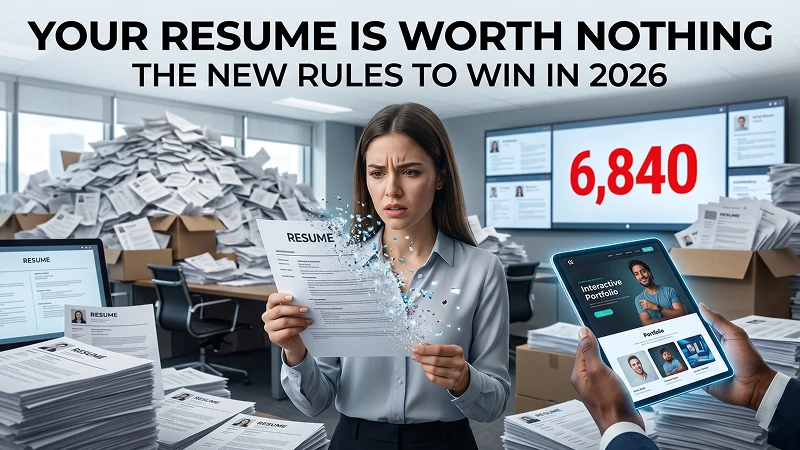
If you're a tech professional, a recent graduate, or anyone with a LinkedIn profile in the United States, you've likely felt it—a low-grade anxiety humming beneath every job application you send. That anxiety was given a name last week when a single social media post went viral, confirming the fears of millions: "Your Resume Is Worth Nothing In 2026."
The post, shared on X by a tech worker named Shubham, described a conversation with a US-based startup founder. The founder needed to hire just Three Software Engineers. They were not a FAANG giant. They were a regular startup. Yet, the response was staggering. They received 6,840 Applications. The candidates weren't just anyone; they included graduates from the prestigious Indian Institutes of Technology (IITs) and Ivy League universities.
Faced with an impossible task of reviewing nearly 7,000 applications, the founder revealed her plan. She wasn't going to use fancy AI screening software. She wasn't going to delegate it to a junior HR person. Her solution was simpler and far more terrifying: she would Randomly Select 20 People For Interviews. If none were suitable, she'd randomly pick another 20.
This isn't a scene from a dystopian novel. This is the 2026 tech job market in the United States. It's a lottery where your meticulously crafted resume, your years of experience, and your expensive degree are just lottery tickets in a pile of thousands. The odds are no longer in your favor.
This article isn't here to scare you—though the reality is scary. It's here to hand you a new playbook. Because if the old rulebook (get a good degree → build a good resume → get a good job) is in flames, we need to learn the new rules of the game. And for freelancers, UI/UX designers, and forward-thinking developers, the new rules are actually better than the old ones.
🤯 The "6,840 Applications" Post: How One Tweet Exposed a Broken System
The post by Shubham (@aShubhamz) on April 18, 2026, acted as a Rorschach test for the tech community. Some saw it as proof that the job market is irreparably broken, a victim of its own success and remote work's global reach. Others saw it as a validation of their own struggles, a reason to stop blaming themselves for not hearing back. And a few saw it as a wake-up call.
The reactions poured in from every corner of the internet:
- The Fatalists: "See, I've been saying this. It's just luck. Pure f*cking luck." This sentiment echoed across countless replies, a feeling that merit and hard work are no longer the primary drivers of success.
- The Bootstrappers: One user pushed back, claiming to have landed 20 interviews in the US as an international student by building projects in public. Their secret? Visibility and a strong portfolio, not a polished CV.
- The "Glycine Bonus": Others pointed to deeper structural issues. One user argued that STEM companies have "Rigged Hiring In Their Favour" to suppress wages. Another noted that referrals still quietly determine most outcomes, making the cold application process a fool's errand.
- The Realists: A sobering counterpoint also emerged: startups aren't a guaranteed safe haven. "Most startups fail, and income stability can be a real concern," one user noted, reminding everyone that escaping the corporate rat race has its own perils.
The consensus? The entry-level and mid-level tech job market is drowning in volume. Even the strongest candidates are becoming nearly invisible in a sea of applications. The system for filtering talent is failing, and as a result, it's defaulting to randomness.
📉 The Perfect Storm: 3 Forces That Made Your Resume Obsolete
This didn't happen overnight. The "6,840 Applications" phenomenon is the result of three major forces converging in 2026.
This didn't happen overnight. The "6,840 Applications" phenomenon is the result of three major forces converging in 2026.
- 1. The AI-First Application Avalanche
Generative AI tools like ChatGPT and Claude have made it trivially easy for anyone to generate a professional-sounding resume and cover letter. What used to take a human a day now takes a bot 30 seconds. The result? Every job posting is now hit with a tsunami of AI-generated applications that all look and sound remarkably similar. This has devalued the resume as a signal of quality. When everyone's resume looks perfect, no one's resume stands out.
This is compounded by the fact that companies are using AI on the other end to filter applications. In a particularly grim report, one hiring team was found to have not interviewed a single human candidate, instead feeding all resumes into an AI system called Claude to do the first-pass filtering. We've created a world where bots are writing applications for bots to read, and humans are left on the sidelines.
- 2. The Great Remote Work Flattening
The shift to remote work has been a double-edged sword. While it's created incredible flexibility and opportunities for workers outside major tech hubs, it has also globalized the talent pool for every single role. That UI/UX designer role in Austin, Texas, isn't just competing with other designers in Austin. It's competing with highly skilled, equally ambitious designers in Bangalore, Buenos Aires, and Berlin. The supply of talent has gone global, but the demand for local roles hasn't kept paces
- 3. The "Efficiency Era" In Tech
After a decade of "Growth At All Costs," the tech industry in 2026 is firmly in an era of efficiency. Fueled by investor pressure and economic uncertainty, companies are laser-focused on profitability. This means they're hiring fewer people and expecting more from each one. The roles that are available are often for senior, specialized talent who can hit the ground running. The "We'll Train You" entry-level job is an increasingly rare breed.
🚀 The New Playbook: 5 Rules to Win in 2026 (When Your Resume Is Dead)
Okay, the old system is broken. We've established that. Now, what do we do about it? This is where the opportunity lies. The new rules favor those who are proactive, visible, and can demonstrate their value in tangible ways. For UI/UX freelancers, this is your time to shine.
Rule #1: Your Portfolio Is Your New Resume
This is the single most important shift. In a world of 6,840 faceless applicants, a PDF of your work history is background noise. A stunning, interactive, and easy-to-navigate portfolio is a megaphone.
- 1. Show, Don't Tell:
Don't just list "5 years of Figma experience." Show the complex design system you built, the user flow you simplified, the A/B test that increased conversions by 20%.
- 2. Case Studies Are Gold:
Every project in your portfolio should be a mini-case study. What was the problem? What was your process? What were the constraints? And most importantly, what was the measurable result? This is the language business founders and hiring managers speak.
- 3. This is Where You Come In:
Your UI/UX freelancing business is perfectly positioned to help people with Rule #1. A common pain point is, "I Know I Need A Great Portfolio, But I Don't Know How To Build One That Looks Professional." You can offer exactly that service.
Rule #2: Visibility Beats Credentials
The user who got 20 interviews didn't do it by having a better GPA. They did it by "Building Projects In Public". They made themselves visible.
- 1. Build in Public:
Share your process on X, LinkedIn, or specialized communities. Post a Figma file. Ask for feedback on a user flow. Write a short post about a design decision you made. This isn't bragging; it's marketing.
- 2. Contribute to Open Source:
Find an open-source project you love and offer to improve its UI/UX. This provides real-world experience and gets your name attached to something tangible.
- 3. Create Content:
Start a blog, a YouTube channel, or a newsletter about UI/UX. Teach what you know. When a founder searches for "How To Improve My App's Onboarding Flow," you want your article or video to be the top result. This positions you as an expert, not just an applicant.
Rule #3: Niche Down to Stand Out
A generalist resume is a lottery ticket. A specialized portfolio is a golden key. The more you can position yourself as the expert for a specific type of problem or industry, the smaller your competition pool becomes.
- Industry Specialization:
Become the go-to UI/UX designer for FinTech apps. Or E-commerce sites. Or SaaS platforms for healthcare.
- Problem Specialization:
Become the expert in designing for accessibility (a11y) . Or optimizing user onboarding flows. Or creating complex design systems from scratch.
This is also a powerful business strategy for your freelance work. When you pitch a FinTech founder, and your entire portfolio is full of FinTech case studies, you are no longer a risk; you are the obvious choice.
Rule #4: Master the Art of the Warm Introduction
If 6,840 people are applying through a portal, the odds of being seen are 1 in 6,840. The odds of being seen if you're referred by a current employee or a trusted friend of the founder are astronomically higher. The game isn't about applying; it's about connecting.
- Leverage LinkedIn (Strategically):
Don't just send connection requests. Follow people. Engage thoughtfully with their content. When you do reach out, have a specific, non-generic reason. "Hi [Name], I saw your post about the challenges with user retention at [Company]. I actually just wrote a case study on a similar problem, and I thought you might find this one insight useful..."
- Network Before You Need It:
The worst time to start networking is when you need a job. Build relationships with other designers, developers, and product managers when you don't need anything. The tech community is surprisingly small and generous.
Rule #5: Embrace a Freelance Mindset (Even If You Want a Full-Time Job)
This final rule is perhaps the most transformative. The mindset of a freelancer—proactive, self-reliant, and constantly marketing their value—is the ultimate survival skill in the 2026 economy.
A freelancer knows that their next project depends on the work they're doing today and the reputation they're building right now. They don't wait for permission. They don't rely on a single employer. This is a more resilient, more powerful way to approach your career.
And for many, Freelancing Is The Ultimate Solution To The 6,840-applicant Problem. It completely bypasses the broken hiring system. You're not a number in an ATS. You're a business owner solving a specific problem for a client who found you through your portfolio or a trusted referral.
This is where your UI/UX freelancing business perfectly aligns with the trend. You're not just offering design services; you're offering an escape route from the corporate lottery.
🧠 Deeper Dive: The Future of Work and Your Place in It
The "Resume Is Dead" narrative is just one symptom of a much larger transformation in how we work. Understanding these broader shifts is key to staying ahead.
- The Rise of "Claude as a Career Filter":
The earlier report about a company using AI to screen candidates without a single human review is not an anomaly; it's the future. This means optimizing for AI is as important as optimizing for humans. How do you do that? By creating content and a portfolio that is so rich with specific keywords, case studies, and project names that it becomes undeniable to both a human reader and an AI scraper.
- Water, Power, and Your Digital Footprint:
While seemingly unrelated, the viral outrage over AI data centers consuming millions of gallons of water highlights a growing public awareness of the cost of the digital world. As a UI/UX designer, you have a role to play in creating more sustainable, efficient digital products. This isn't just good for the planet; it's a powerful and unique talking point that will set you apart in client meetings.
✅ Your 7-Day Action Plan to Beat the System
This article isn't meant to be read and forgotten. It's meant to be a catalyst. Here's what you can do in the next 7 days, starting today, April 20, 2026:
- Day 1 (Today):
Audit your online presence. Does your LinkedIn profile link to your portfolio? Is your portfolio a living, breathing showcase of your best work, or a dusty collection of old screenshots?
- Day 2:
Identify your niche. What industry or problem do you genuinely enjoy solving? Update your portfolio and profiles to reflect this new focus.
- Day 3:
Find one project to contribute to or build in public. Write a LinkedIn post about a design problem you're currently solving. Share a screenshot.
- Day 4:
Connect with 3 people in your niche on LinkedIn. Don't pitch them. Just follow them and leave a thoughtful comment on a post.
- Day 5:
If you're considering freelancing, outline your service offerings. What exact problem do you solve for a business? How can you communicate that clearly on your website?
- Day 6:
Apply Rule #1 to yourself. Look at your own portfolio and ask: "Would This Make A Founder Stop Scrolling And Say 'I Need To Talk To This Person'?" If the answer is no, you know what your next project is.
- Day 7:
Take one concrete step toward building a public body of work. Publish a short blog post. Create a YouTube video. The goal is visibility.
✅ Your 7-Day Action Plan to Beat the System
The viral post about 6,840 applications and random selection is a brutal but necessary wake-up call. It confirms that the old social contract—work hard, get a degree, get a good job—is being rewritten in real-time. It's easy to feel like a powerless lottery ticket in this new world.
But you are not a lottery ticket. You are a UI/UX designer, a developer, a creative problem-solver. The new rules, as harsh as they seem, actually give you more power. They reward the people who can show their work, not just tell about it. They reward the people who are proactive, visible, and generous with their knowledge.
Don't curse the fact that the game has changed. Learn the new rules. And if you need help building the one asset that matters most—a powerful, undeniable portfolio—that's exactly what we do. You focus on your work. We'll help you make sure the world sees it.